Monday, July 27, 2015

“Keep me away from the wisdom which does not cry, the philosophy which does not laugh and the greatness which does not bow before children.” - Khalil Gibran
2009-09-08-16h36m16.jpgOver the past week, I’ve had the delightful opportunity to spend time with some young friends who were visiting us from Canada and one of the topics of our conversation was how I intended to spend my time once I retire. I’d come home from work to hear wonderful stories of their adventures seeing San Francisco, Yosemite and Sequoia National Park for the first time and this lead to some discussions of the volunteer work I have done in Yosemite for more than 25 years.


My friends assumed, correctly, that one of the most important things for me in retirement would be to continue to make a difference. We talked about my interest in doing more volunteer work in the national parks and working to help children and adults learn to read. We also talked about some very social activities, like making music with friends, and some more solitary and contemplative pursuits like writing and composing. I hope to spend a fair amount of time on creative pursuits like woodworking, art, and blacksmithing, too.


Conversations like these always seem to help me as I prepare for retirement and I appreciate that friends have an interest in what will come next for me. Now that our friends have begun their journey home, I find myself thinking about our conversations and about the stages of life we all experience. I listened to them and remembered earlier stages of my life and I imagine they listened to me, and listen to their parents, and think about the changes they will some day experience when they are my age.


All of this reminds me today of a Hindu way of describing the stages of life that has seemed very useful to me since I first encountered it some forty years ago. While I don’t pretend to have a deep understanding of Hindu belief or philosophy, and while I am sure I would not agree with all of the teachings in texts like the  Manusmá¹›ti that provides one of the earliest descriptions of this system
the simple idea that there are a four clear stages to life, and four key goals, has been interesting and helpful to me for many years.


The Ashram system describes four Ashrama, or stages, of life: Brahmacharya (student life), Grihastha (household life), Vanaprastha (retired life), and Sannyasa (renounced life). As a student, the young person is in a stage of life focused on learning, practicing self-discipline and learning to live in the right way. I remember this part of my life and appreciate my parents, teachers and friends who helped me learn and grow. As a householder, a person spends their time and energy enjoying family life, attending to their duties to their family and society, and working to earn a living. The householder also takes responsibility for children, students, and elders.


As I prepare to move from that stage of my life when I have primarily been a householder and to enter retirement, I am grateful to my family and friends for the rich and rewarding experiences I have had as a father, an uncle and great-uncle, a worker, a boss, and especially a spouse and a friend. I’m glad that I’ve had the chance to work to provide for my family! I’m also very glad that my roles as spouse, father, uncle, great-uncle and friend will continue in retirement. I’m ready to let go of being worker and boss and hope to one day be a grandfather, too.


In the Ashram system, the retired life allows a person to gradually withdraw from the world, freely share their wisdom with others and prepare for the final stage of life. For my part, I hope, and expect that the process of withdrawal will be very slow and gradual. While I am ready to set aside the duties of my profession, there are many new things I look forward to engaging in with my time and energy and I am especially looking forward to having more time with my loved ones.


Some day, I imagine I will be ready for something akin to sannyasa when I will focus more and more on leaving this world in the best way. While I have watched some who have gone before me live through this stage of life, I have much to learn before I will understand it better. I hope I will have many years to do that learning.
In these Hindu teachings, a life lived in this way helps a person fulfill four key aims: Dharma (living in the right way), Artha (meaning and purpose), Kama (the aesthetic enjoyment of life, love, and emotional fulfillment), and Moksha (liberation, freedom, self-realization and self-knowledge). If I were to live a life that allowed me to find, and balance, these things, I’m certain that would be a life very well lived!


As I prepare to move to the next stage of my life, there is work I look forward to doing that I will be more free to do by not having to earn a living. In addition to volunteering in the parks and for literacy, I’d like to work for gender equity, climate change and sustainability to help ensure that all our children, grandchildren, and their children and grandchildren, live in a world better than the one we inherited from our parents. These are ambitious goals I’d have to pursue with a certain amount of faith as we will surely not live to see all the results of our efforts.

I also look forward to more time with nature, hiking and stargazing, to more meditation, music, laughter, love, and quiet times with family and friends. I’ll be preparing over the next 22 months. I know I have so much to learn and I’m sure there will be challenges and surprises in this new stage of life. I’m pretty sure I’ll be ready for those!

Monday, July 20, 2015

"We take care of our health, we lay up money, we make our room tight, and our clothing sufficient; but who provides wisely that he or she shall not be wanting in the best property of all--friends?” - Ralph Waldo Emerson


As I return to work after our recent vacation with dear friends, I am very aware of what matters most to me in life. My idea of a successful career is one where the work I do provides enough for my family and time for me to spend with them and with friends.

A neighbor of mine recently lamented that too many of us strive for financial success at the expense of all else. He said to me “It seems the goal is to work hard and die rich.” I said to him, that I’d prefer to work hard enough to support what really matters and die happy. I'll never be wealthy but, if I am successful, I will live a life that is rich in the love of my family and friends.

Another friend recently asked me how I know whether I am successful, how this has changed over time, and what were the main things I have learned in the course of my career that made a positive difference. I thought her questions were very good and I enjoyed thinking about my answers.

For me success has come to have a lot to do with balance. While I have had other executives tell me that work/life balance just doesn't seem possible, I'd consider surrendering on that issue to be failure. So, I consider myself successful when I am able to provide excellent service to my university, balancing requirements with resources, while remaining fully present and engaged with my loved ones. Ultimately, I am a man who works in IT and success means giving the life I live with my loved ones first priority.

My definition of success hasn’t really changed all that much over the years. I've always valued family first. Very early in my career, success for me was more about finding ways to move up the value chain at work so that I could earn a better living. There were also times later in my career when I got out of balance trying to provide more to the university than was reasonable. Working an average of 50-60 hours a week in an effort to meet the expectations of "doing more with less" during a budget crisis contributed to some health problems and helped me refocus on a healthy balance.

Some of the key lessons I’ve learned are these. Ultimately, we can only do so much. Taking time to understand priorities and set clear expectations is valuable and necessary. I can remember saying to a new boss of mine "What we can do, we will. What we can't do, we won't". Sometimes it's that simple.

I've always struggled with saying "no" and that is still true today. What I have managed to learn is how to shape what I am saying "yes" to instead. When I can't say "yes" to the initial ask, I can talk about options and what is possible, or what is a reasonable step toward the ultimate goal. Most often, we can arrive at something that is helpful, appreciated, and achievable.

Roy Disney said, 'It's not hard to make decisions when you know what your values are.' I've learned that this is entirely true. We strive to do what is right and that simplifies so many things. Part of this is remembering that we are people working together to accomplish meaningful objectives. Doing what is right with a group of people you respect can be very rewarding.

The greatest measure of success in life for me is love. My purpose in working is to care for those I love and to afford myself the opportunity to express and experience love in my life. They say you can't take it with you, and I'm sure this is true of material wealth. When I die, the things I have accumulated will be left behind. I believe there is one thing that goes on and that is love. The love I've shared with my loved ones will continue, both here on earth and on out into the universe of whatever comes next.

Most of this is a deep mystery for me but I'm quite sure about the infinite permanence of love. In love, my beloveds and I are together everywhere and always, even beyond the end of space and time. We always have been and we always will be. The appearance of separateness is an illusion associated with the way we experience the universe as human beings. I believe there will one day be a physics and cosmology that help explain this. For now, it will seem like metaphysics. So be it.

This past week has given me time to spend with some of my dearest loved ones, time to relax, and some quiet time to reflect. I return to work with renewed energy and a renewed awareness to why I do the work I do.

Monday, July 13, 2015

"Let choice murmur in your ear
And love murmur in your heart.
Be ready... here comes life."
Maya Angelou
100 Mondays C.jpg


As I post this entry to “100 Mondays”, I am on vacation with family visiting our loved ones in Canada. I wrote the thoughts below during some quiet moments over the Fourth-of-July weekend so that I could honor my choice to put my family and loved ones first while we have this time together.

Each day, we make thousands of choices. There are simple choices, like what word I choose to use next in this essay, and difficult choices, like how to respond to a difficult personnel situation. There are trivial choices, like whether to have coffee or tea with breakfast, and vitally important choices, like whether to stay in a job or seek a new opportunity.

Some choices affect no one but ourselves and others will impact the organizations, and people, we serve, or the lives of our loved ones. There are choices we make in the happiest moments of our lives and some made in our deepest moments of crisis or despair. Some of us face choices that mean the difference between life and death for ourselves or others.

The way I make choices has changed significantly over the past 35 years. Although my basic values haven’t changed all that much, I have learned a number of things that have helped me make better choices. Most of these are pretty basic life lessons, but it seems it took me some living to learn them.

One of the earliest lessons I learned is that we are much more together than any of us can be alone. The most exciting, and rewarding experiences in my early years were working with teams delivering amazing results for clients in the savings and loan industry. There was lots of overtime, situations where we had to invent new solutions in the course of a weekend, and moments when it felt like we were sending a rocket to the moon. I learned that the best choices for me would be those that let me be part of something greater than myself.

A much harder lesson to learn was that each of us is responsible for our own happiness. It took years of my not being able to make others happy and of not being made happy by what others did for me, and a failed marriage, to learn this one. I fought this learning but, in the end I learned to choose what will make me happy and, what was much more important, to fully accept the responsibility for the results of my choices. Now I can choose to do things for others because it brings me joy to do so, and I can experience joy in the things others choose to do for me, without expecting that we will make each other happy.

I’ve long understood that money isn’t everything, but I’ve learned how freeing it can be to choose those things in life that are so much more important. Working in education is not the path to wealth, but the working to make a real difference with colleagues who care about this work has been a good choice. Given the choice of pursuing a higher-paying job in another city or staying with the woman I had fallen in love with, and her children, it was clear that more money paled when compared to more love.  I’ve chosen to be with family and to have less stress over money. The less stress thing hasn’t always worked out, but I’m very happy with my choice.

Then a day came when my wife and I faced a choice between money and freedom. Her job stress was climbing while her satisfaction in her work was declining and she had the opportunity to accept a volunteer role that would allow her to work in her passion. With the help of a good financial advisor, we were able to tighten our belts a bit, define a better budget, and make that work. I can honestly say, we’ve never regretted the choice and it has enriched our lives immeasurably for many years now.

While I haven’t done a very good job of learning to say “no”, I am learning how not to say yes to things that are wrong for me. Earlier in my career, any new opportunity to make a greater difference received an automatic “yes” from me and I figured I’d be strong enough to take it on and make it work. Today, I realize that some of the making it work needs to be part of the decision-making process and to include making it work for me. Recently, I am choosing opportunities to make a more measured contribution that are healthier for me.

As I begin considering what I will choose in retirement, I imagine there are still life lessons waiting for me. I’m sure I’ll still need to work on when to say “no” and when to say “yes” and that this new adventure will unfold in ways that surprise me. I still remember being at a concert where Bob Dylan and the Band played “It’s Alright, Ma (I’m Only Bleeding)” and I’m still sure I agree that “He not busy being born is busy dying.” I look forward to being busy being born for many years to come.

Monday, July 6, 2015

"Sometimes thoughts could not be helped, for they were live and unpredictable things with hidden motivation of their own." - W.O. Mitchell in "Who Has Seen the Wind


100 Mondays B.jpgToday, I find myself thinking about motivation and how essential it is to understand what motivates us, the people we lead, and the leaders we follow. In my career, I have found it easiest to understand my own motivations, and more challenging to understand what motivates the staff and leaders I serve as a manager. Adding to the challenge of understanding the motivations of staff is that they are at different stages of their careers, play significantly different roles in the organization, and have differing priorities depending on their own goals and personalities. While I can gain insights into the motivations of our leaders by listening to them and reviewing strategic plans and other documents, I believe the factors that motivate them are relatively complex and I am less aware of their personal objectives. In addition to pursuing broad goals like student success, they face pressures from state and federal officials, donors, and system-wide priorities. I will listen to understand them as well as I can and I will wish them well.

I gain some insights into staff motivation by considering how my own motivations have changed, and remained the same, over the course of my working life. During the earliest portion of my career, the opportunities to prove myself, demonstrate my problem-solving skills doing interesting work, have access to training, and advance to more responsible positions were more important. Once I had established myself, being trusted to act independently and opportunities for professional development that would help me grow as a manager gained importance for me.

Throughout my entire career, I have been motivated by a desire to make a difference, to be included in relevant decision making, and to work for leaders I can trust, and who trust me. Stability that helps me offer my family security and overall satisfaction and happiness have been very important to my being able to give my best and consistently seek to provide more value. Today, as I plan the end of my career in IT, having the respect of my peers, and the opportunity to help position those I work with, and the initiatives we are pursuing, for success in a way that will extend beyond my planned retirement are especially motivating to me.

Some of you may wonder why I haven’t mentioned compensation. While I have respected colleagues who don’t agree, I simply don’t think that money is an effective motivator. Although I work to make a living, it isn’t the money that motivates me to do good work and strive to make a greater difference. Instead, I agree with those who would describe money as a satisfier. While I have always appreciated increases in my salary, and especially those that recognized the special value of my efforts, the impact of these on my motivation has always been short-lived. I have found it easy to get used to each increased level of income. Once this occurs, that salary becomes the new normal and ceases to motivate me. In the later part of my career, I’ve taken on much greater responsibilities with no additional compensation or, in one case, an increase that was clearly not enough to compensate me for the added stress and effort of more responsible duties. I was motivated to accept these challenges because they allowed me to make a difference and reflected the respect and trust of the leaders I serve.

While I don’t think money is a motivator, I do think that dissatisfaction can be and I know that it has been for me and for colleagues I respect. This can take the form of being dissatisfied with salary and I think this confuses the way we discuss money as a motivator. While I don’t believe more money will motivate people to increase the value of their work for long, I do believe that dissatisfaction with too little compensation can motivate people to prove they deserve a raise. Unfortunately, this situation is also one that often prevents us from retaining valuable employees. They can resolve their dissatisfaction by finding a better job elsewhere.

Another way we confuse money and motivation is to think that recognition in the form of financial bonuses or greater investment in an employee means that the employee has been motivated by the money. I don’t believe this is what takes place in these situations. Instead, I think the money represents in a tangible way, and helps communicate, the respect, appreciation, and trust we feel for the employee. What is motivating is this feeling of earned respect, appreciation, and trust. I think the desire to retain, and expand, these deeply important intangible gains is the motivator.

The most important examples of dissatisfaction as a motivator in my career have had nothing to do with money and I’ll provide two examples. Feeling dissatisfied with the negative impact that stress was having on my health, my family, and the quality of my life, I was highly motivated to identify changes I could make in the way I do my work that would allow me to reduce the stress I experienced while maintaining my ability to make valuable contributions. To reduce my dissatisfaction, I sought help from a therapist, made changes in the number of extra hours I spent at the office, or working at home, and redoubled my efforts to use my time at work wisely.

My feelings of dissatisfaction with the way IT was governed at my university, and with the value IT was able to provide as a result of our governance, motivated me to work for over 15 years to support a change that would see the creation of a CIO role reporting to the president. This was  the “flip side of the coin” to being motivated by making a positive difference. Because I was dissatisfied with the difference we were able to make, and with the respect and recognition being provided to the IT professionals I managed, I was highly motivated to work for a change. Our new CIO will start this fall and I will remain highly motivated to ensure the new approach is successful.

Our insights into the inner lives of others, including their motivations, are limited. Often, we act based on the belief that their thoughts and feelings must be essentially similar to ours and then watch the results to see where this belief is supported or proven incorrect. In my professional life, I have become convinced that many other IT professionals are motivated by many of the same things that motivate me. They seek the opportunity to do interesting, and challenging, work that allows them to prove their ability to solve problems and deliver valuable solutions. While the notion that their are no problems, only opportunities, may seem too optimistic even to me, I can’t tell you how many IT professionals I’ve met who respond strongly to the spirit of the old Journey song “Only Solutions”.

IT professionals want to work for leaders they trust and to be directly involved in the decision-making process by providing insights based on their knowledge and experience. They want to be respected, valued, and trusted because they have earned these things. They want to be relevant, to have enough stability to feel secure about their futures, and to make a difference. They want to be happy.

Ultimately, I think that most of us are motivated by similar things. This challenges those of us in leadership positions to find ways to provide opportunities, recognition, and rewards that speak to these motivations and to celebrate with our teams when we achieve our goals. Coming back to my own motivations, the last thing I’d want to have included in my epitaph is “He meant well…” I want to DO well, to make a difference, earn the trust and respect of my colleagues, and be happy. I don’t think retirement will change that.

Monday, June 29, 2015

"Never doubt that a small group of thoughtful, committed citizens can change the world; indeed, it's the only thing that ever has." - Margaret Mead

32[1].jpg
The opportunity to spend a couple days with some wonderful colleagues last  week has me thinking about the great benefits we receive when we work together. I’ve written about the value of volunteering and that is certainly a rewarding experience. Today, I am thinking more about working together in our professional roles.

I’ve been very fortunate in my career to work in environments where most of the people were genuinely motivated to work together in pursuit of the vision, mission and goals of the organization. My colleagues have generally been eager to share their knowledge, experience and perspectives, and to listen openly to what others had to share, to help ensure our success. Most of the leaders I have served under fostered this kind of cooperation and served as role models in their own engagement with colleagues.

Across a wide range of situations, from cooperation within work groups and teams, to collaboration within and across departments and organizations, I’ve experienced the power of people coming together in service of shared objectives. I’ve seen this dynamic at work in campus-wide committees and initiatives, and in system-wide groups like the Information Technology Advisory Committee (ITAC) that I spent time with last week.

As ITAC gathered, with CIOs from across a large multi-campus system representing their universities, I watched with real admiration the way these colleagues choose to work together. I’ve been fortunate to work with this group for a number of years and I was struck again with the diversity of their knowledge and experience, the respectful way they work together, and the commitment and energy they bring to this work. The needs and cultures of their campuses differ and the best solution for one will not always be suitable for another. Still, they come together with mutual respect to search for answers.

I admire the way the members of this group seek opportunities for common action and benefit from understanding how the different organizations they represent are unique. Their work together provides an excellent example of how it is possible to share the effort, and benefits, of seeking standard system-wide solutions, forming smaller communities of interest where appropriate, and sharing experiences and knowledge that can benefit us even when we choose unique answers for our campuses. Often the pioneering work of one, or a few, will ultimately benefit all and I appreciate the spirit of generosity and collaboration they exhibit.

Although this recent experience was another positive example of how we can work together, I admit it’s not always easy. Some problems are perennial and even with all the best intentions and great good will, we can find ourselves struggling with them for years. Cynicism is a real danger at times like these and it can take real creativity, and patience, to find a way forward.

Even when we are paid to do a job for an organization, we don’t necessarily work effectively with all our colleagues. While we may all be “riding for the same brand” there are times when we find ourselves failing to connect to do good work together. There can even be personal, or personality, conflicts that can threaten to undermine the work we are engaged in together and I have faced a few situations where I wasn’t sure I could find a way past these. To be clear, none of those was at ITAC. 

There are many issues that can get in the way of effective collaboration. Our goals may be, or appear to be at odds. We may find ourselves in competition for resources or in championing different approaches to a shared objective. We may disagree about priorities and, sometimes, we may need to find a way to disagree respectfully. With luck, we may find ways to move ahead separately to a point where we can rejoin our efforts.  One answer has been to recognize when I needed to set aside my preference and support a solution that would not have been my first choice. Not every group will represent the power of working together and I’m sure we have all experienced those times when it seems a committee is the worst possible way to find a real solution.

It takes real leadership to bring people together, or through the hard times, to carry on good work. I don't believe that you can compel people to come together in this way. We must inspire them to do so for good reasons of their own by appealing to common interests and to their desire to improve things through their shared effort. We must meet them with respect and listen with open minds for the wisdom they have to share. We must help them meet one another with respect, openness, creativity, and patience. When we work around, or rise above, the challenges inherent in working with others toward a common goal, it almost always makes us stronger.

For my part, I am deeply grateful for the opportunities I have had to work with groups of colleagues. I’ve built a network of peers, and friends, and I’ve learned more from our work together then I ever have working alone. The perspective I’ve gained, and the growth I’ve experienced, as we faced challenges and celebrated accomplishments are invaluable. The opportunity to contribute, and the good times we’ve shared, have been among the highlights of my career.

With the end of our meetings last week, my work at ITAC has come to an end. Endings are part of this phase of my career that I am exploring as I write. I find that they afford me the opportunity to look back and reflect on what I’ve shared with others, what we’ve accomplished and how I’ve grown and changed. I find they also give me the chance to look forward with happy anticipation to what comes next. I know from past experiences, like the one I had in my volunteer work at SHARE, that the best times may well be ahead of me.

(The photo at the head to this weeks article is from Sulphur Mountain in Banff; one of the many great team-building experiences I enjoyed with the SHARE Board of Directors.)

Monday, June 22, 2015

"Therefore, desiring to rule over the people,
One must in one's words humble oneself before them
And, desiring to lead the people,
One must, in one's person, follow behind them." - Tao Te Ching
100_4583.JPG


Today, I am inspired by a nightly occurrence in our household to write about herding cats. For many people this is simply a humorous, and helpful, metaphor for a situation where we try to bring disparate independent, and often unruly, elements into alignment to achieve some goal. The Wikipedia entry describes herding cats as "An idiom that refers to a frustrating attempt to control or organize a class of entities which are uncontrollable or chaotic."

I particularly like the way the Urban Dictionary defines this - "The phrase herding cats comes from the common saying that something involving coordination of many different groups or people is as difficult as herding cats. One of the commonly encountered uses of the term in technical fields is the phrase "Managing programmers is like herding cats" or "Managing engineers is like herding cats". In education it would be "Managing students is like herding cats". In reality, it would be "Managing cats is like herding cats." It refers to the individualism common in the stereotypical examples of programmers and domesticated cats. A similar phrase, allegedly of Irish origins, is 'Minding mice at a crossroads'". http://www.urbandictionary.com/define.php?term=herding+cats

I hadn’t heard “Minding mice at a crossroads” before and I like it! One of the things I particularly appreciate about their definition is that it honors the individualism of programmers. I’d extend this to IT professionals in general and I’m sure it applies to many other groups. I think that one of the keys to successfully herding cats, literally or metaphorically, is to respect their individualism and the way they value their independence. It can be important to consider the perspectives of different members of the team, to think about what will motivate different people to move in the direction you want, and to remember who they are ready to follow.

Herding is generally a management function. A manager can act by exerting authority to direct the actions of others. The cowboys herding cattle whistle and shout, use their horses and ropes to channel them in the right direction, and generally outsmart them all the way to the destination. Thank goodness, the people we manage and lead have very little in common with cattle! It is their intelligence, independence, and creativity that we value and that we rely on to help us define innovative solutions to users’ requirements.

While management techniques can have some value in herding these cats, more often it takes real leadership. In contrast to a manager, a leader effectively communicates a vision and, to the extent that the vision is compelling, followers will choose to help achieve it. You may be able to get some distance toward your goals by simply directing your team to please do what you are asking. To reach the final objective, you’ll likely need to appeal to their individual strengths by defining your vision in a way that makes them want to use their skill and knowledge to reach the goal.

Most of us have to play the roles of both manager and leader and I’ve learned a lot about both from my wife. In addition to being a skilled and passionate educator, she is the best mother I’ve ever seen. I’m proud of our sons and I know that she, and they, deserve most of the credit for what wonderful men they are. Once, when I asked her about her outstanding ability as a mother, she said it was important to have a clear idea what you are hoping for, and what behaviors you will, and will not accept, and to be clear about that.

She said she began thinking about this well before the boys were born. I know that she has always communicated clearly, and consistently, with them about what was expected and that she insisted on correct behavior when that was necessary. She managed them fairly, but firmly, and got great results. She also had a clear vision from the beginning and she lead them to realize those goals.

She treats them, always, with real respect and love. She offered them options that spoke to their individual strengths and preferences. She talked with them about what she wanted and why it mattered. She listened to what they wanted and adapted her vision to better align with their interests. As they grew, she gave their perspectives and independence greater and greater weight and helped them grow strong as individuals. She is an amazing leader, in her work and at home, and I watched the boys choose to follow her with love.

While the role of mother is so much more than manager and leader, the lessons of leadership I’ve learned from my wife, and others, can help you herd your cats. If you clearly define your expectations and communicate your vision, and honor their individuality and ability, they may impress you with their results.

I can remember a time when I managed the creation of a new group of systems staff from three, very different, groups. We were combining our Windows sysadmins, Unix sysadmins and mainframe systems programmers into one team. On the surface, the cultures of these three groups were significantly different and I remember thinking at the time that it was like putting cats in bag! Ultimately, I told them so. At a meeting with the combined team, I shared that thought and told them how much I like cats. I acknowledge that we had some different cats in the room. Maybe some were more like Persian cats, some more like Siamese cats, and others more like the tabby cats we see in such variety. Maybe there were even some alley cats ready for a fight.

I asked them to think about what made them different, and also about how they were the same. I started outlining my vision for the new group in ways that I hoped would help them adopt it as a shared vision. I talked about the special strengths that people in each of the former groups brought to the table and also about the things they all shared; like their commitment to delivering reliable systems that performed well and their desire to do things right. I asked them to think about what it would mean to be one group of cats more than three groups of different kinds of cats.

Ultimately, I left a lot of how the new group would form up to them and they found their own best ways to build trust and create a new culture around their shared values. As a manager, I laid out what we needed to accomplish. As a leader, I invited them to participate in defining how we’d achieve those results. In the process, I saw the power of the first follower in action. Once a respected member of this community chose to get on board, the others found it easier to join in.

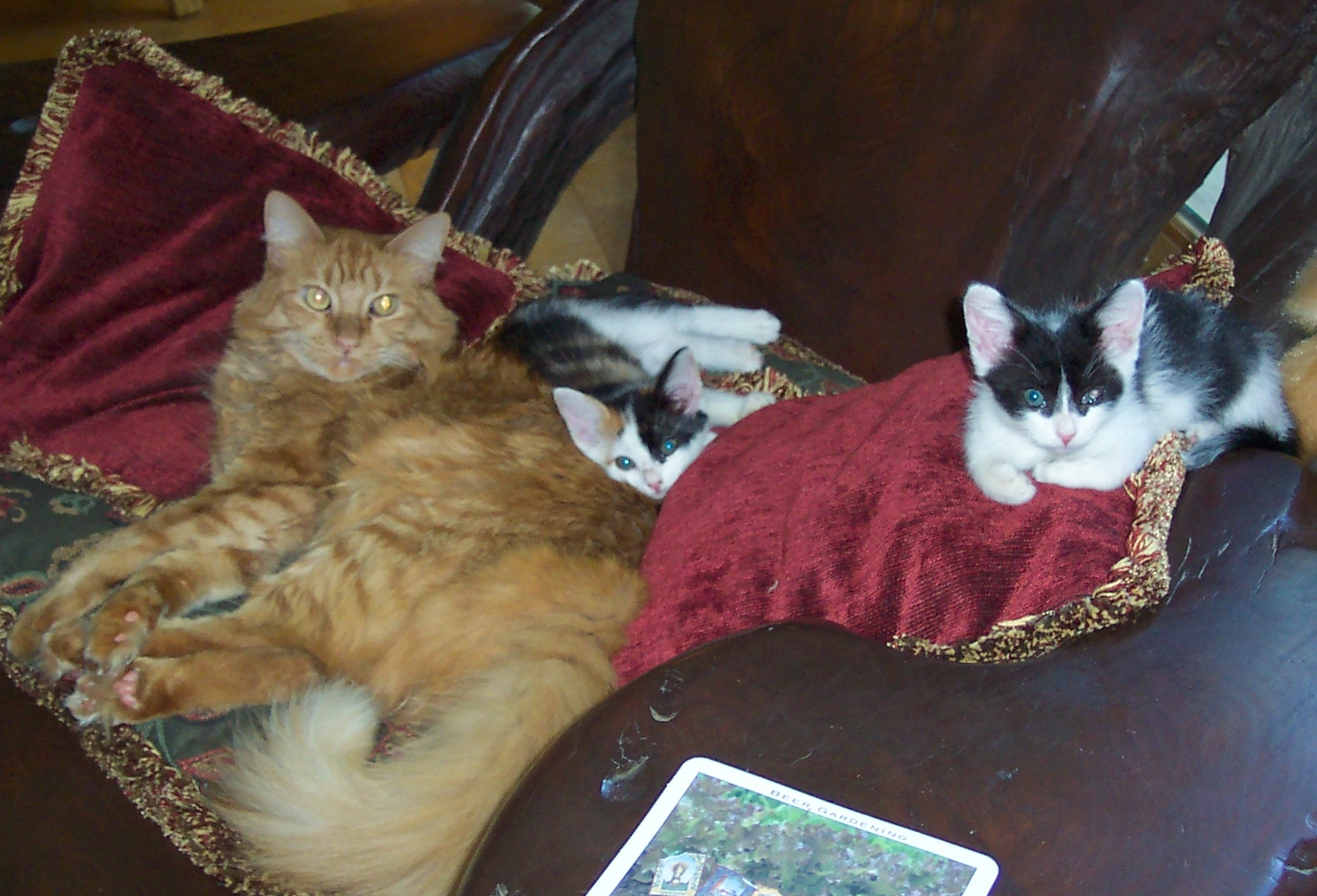
The picture at the start of my post today must be ten years old. It is of our cat Olema with two kittens who are grown cats today. We weren’t sure how he’d accept these two; orphaned so young my wife had to hand feed them every four hours at first. He chose to be father and mother to them! He cleaned them up after feeding time and looked after them throughout the day. He’s been gone for some time now, but I still think of him at the end of the day.

You see, we have four cats in our house now. The two kitties above, a middle cat we found in a log in the forest, and a new kitten whose current nickname is “The Terrorist”. She’s actually a sweetie and when it’s bedtime, she’s often the first follower who helps with herding cats at our house. Sometimes, she will follow me down the stairs to the cat room where they sleep and the others will follow along. They do need more or less encouragement depending on the night! Often one will insist on being carried down and sometimes we all laugh about this process.

Of course, even with all the best intentions, sometimes its just like… well, herding cats!

Monday, June 15, 2015

“Time may change me, but I can't trace time." - David Bowie from "Changes"

1916546_541877690911_4239212_n.jpg
Recently, a younger colleague who has been reading this blog asked if I’d consider writing about the changes I’ve seen during my career in IT. He was particularly interested in the concepts that have remained relevant across the years and in how current cloud computing models are similar to the service bureau environment where I started. I hadn't thought about this topic for 100 Mondays, but it's a good one! I also admit that thinking of 100 things to write about is going to be a challenge and I appreciate the suggestion. Thanks, Lars!

My interest in computers started in high school and my first computer programs were recorded on punched paper tape and stored with rubber bands around them in a mason jar on my shelf. For some reason, I didn't actually consider a career in IT and graduated with a degree in psychology after starting out majoring in enology.  I do remember hanging out in the computer lab at university but I never actually took any computer science or IT classes before I graduated.

I began my career in IT when I needed to make more money as I considered pursuing my Master's degree. I answered an ad in the paper and ended up as a computer operator on an IBM 370 mainframe working with punch cards and green-screen terminals. I taught myself some assembler language programming and then took a class from a colleague and got my next job as an assembly language programmer in the banking industry.

From there, I continued working in IT as a mainframe systems programmer, in storage, capacity planning, quality assurance, Unix systems administration and other technical pursuits. I was hired by the university to help them migrate to an IBM 3090 mainframe and ultimately moved into management. I've managed systems programmers and systems administrators, the help desk, networking, and ultimately took on my current role as Executive Director for Technology Services. We've just hired the first CIO in our university's history and I'm very pleased with this change and looking forward to helping with the transition to get the greatest value from having IT represented on the president's cabinet.

In the course of my career, I’ve worked with many systems including IBM mainframes, Prime, PDP and VAX minicomputers, and IBM, Apple, NeXT, Sun, Silicon Graphics and Dell microcomputers. These used a wide range of operating systems, storage, memory, database, network, printing and display technologies. I’ve worked with various virtualization environments from VM/370 to z/VM, VMware and others. I’ve watched the introduction of personal computers and seen the software they use evolve from offerings like CP/M, VisiCalc, CompuServ and Mosaic to modern operating systems running programs like Excel connected by the Internet and the modern web providing social media sites like Facebook and Twitter, and cloud computing including Google offerings for just about anything. Along the way, I’ve seen the emergence of Unix, Linux and technologies that allow up to 8,000 virtual servers to run on a single IBM z13 mainframe.

Some of my colleagues will remember wiring boards for the IBM 402, mounting tapes and disk packs and not only TSO, but WYLBUR and Interact, too. For the rest of you, my lapse into nostalgic jargon above isn’t really very important. I hope you can find it more amusing than annoying!

What  is more significant is what has remained relevant across all these changes. From time-sharing systems running on mainframes, through distributed client/server computing, to the current cloud-based offerings what has remained important are things like reliability, availability, performance, flexibility, and security.  While I may find cloud computing eerily similar to the service-bureau environment I started in, with the data in the data center and the user accessing it from a terminal, IT is still mainly about people and relationships. What matters is how well we can communicate our requirements and work together to deliver value by making information out of data.

What drives people to adopt new approaches to IT, and abandon old ones, remains the same, too. We flee higher costs for the promise of cheaper, more powerful, computing. We gravitate to new solutions that provide more useful ways of analyzing, and visualizing, information. We forsake the limitations of old paradigms for the promise of innovative ways to do our work. We embrace revolutionary new capabilities that allow us to tackle problems that were beyond our ability until now.

Over and over again, we will choose to build our own solutions when waiting for others to meet our requirements takes too long. Then we will surrender that independence, or have it taken from us, in exchange for the greater efficiency of a more standard approach. Sometimes, we will get caught up in trends and leave valuable tools behind in pursuit of shiny, unrealized, promises. In March of 1991, Stewart Alsop, the editor of InfoWorld and a very insightful person, wrote, "I predict that the last mainframe will be unplugged on 15 March 1996." Sometimes, we will be wrong.

The mainframes are still here, processing the vast majority of our financial transactions and playing a key role in most major industries. Distributed computing is still here, helping us achieve the flexibility we need to meet our wide range of computing needs. Cloud computing is here now, too, offering a new way to access a wide range of computing options in a simpler way. Behind the clouds shine cheap commodity computers, super computers and mainframe power and reliability. We watch in hope that the promise of efficiency, flexibility, and power, the dream of a real computing utility, is about to be realized.

If the promise does come true, I’m confident that thinking about computing the way we do at the enterprise level will be fundamental to making that happen. The mainframe mentality that encouraged us to think about computing environments as requiring very high reliability, availability, and serviceability (RAS) is still relevant today. After a prolonged outage of one of our distributed servers lately, I have an even keener appreciation for those mainframe systems I worked with 35 years ago! High performance and capacity are needed but the ability to assure that the right capacity and performance is available for each request, so that we optimize the use of scarce resources and deliver reliable service, is fundamental. I’m grateful to my early mentors and to SHARE for teaching me to think this way.

Whether we are using a utility computing environment for the serious business of commerce, healthcare and government, or to play, connect with each other, and share our passions across the face of the planet, a service we can count on to the point that most will take it for granted will be necessary. I look forward to watching that service continue to emerge and evolve.